
We excel at everything from mitered and tiled fireplace walls, to floor-to-ceiling surrounds, traditional hearths, travertine patios, porcelain pool decks, glass mosaic waterline tile, brick-look tile, floating floors, outdoor kitchen surrounds and more. Custom Tile of Austin has been leading the craft of tile installation since 1983 - expertly installing fireplace and outdoor tile for homeowners, interior designers, general contractors and architects across Austin.
Fireplaces and outdoor surfaces sit at opposite ends of the temperature range a tile assembly can be asked to handle: a fireplace cycles through high heat for hours at a time; an Austin patio bakes in the Texas sun, then takes the occasional hard freeze. Both demand different substrate prep, different adhesives, and different expansion planning than an interior wet zone. Built correctly, both last for decades. Built incorrectly, the failures show up the first season.
The kinds of fireplace and outdoor Tile we install
Most of the projects we run land in one of these categories:
- Traditional fireplace surrounds. Tile or stone around the firebox, often paired with a stone or wood mantel and a tiled hearth. Marble, limestone, travertine, handmade ceramic, or brick veneer in classic patterns that frame the firebox without competing with it.
- Modern full-height fireplace walls. Floor-to-ceiling tile that turns the fireplace into the visual anchor of the room. Mitered corners add visual dimension without the trim outlines. Worth doing when the design wants the fireplace to do real architectural work in the room.
- Two-sided and see-through fireplaces. Tile and stone on both faces of a double-sided firebox, often coordinated with the same material on both sides for a continuous read between rooms. Layout and mitered corners get planned across both faces in the design phase.
- Tiled hearths and raised hearths. Stone or large-format porcelain on the hearth surface, set on a non-combustible substrate to code with proper clearance from the firebox opening. Often carried out as a continuous surface with the floor for a flush, modern look.
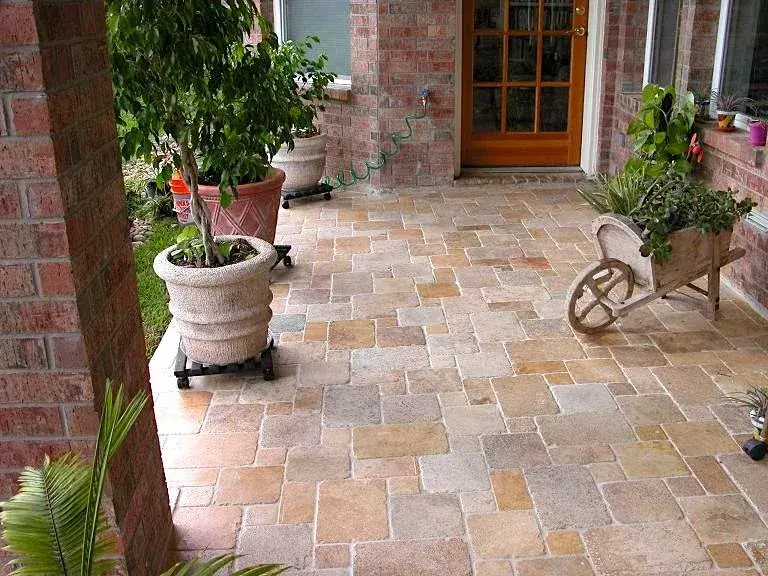
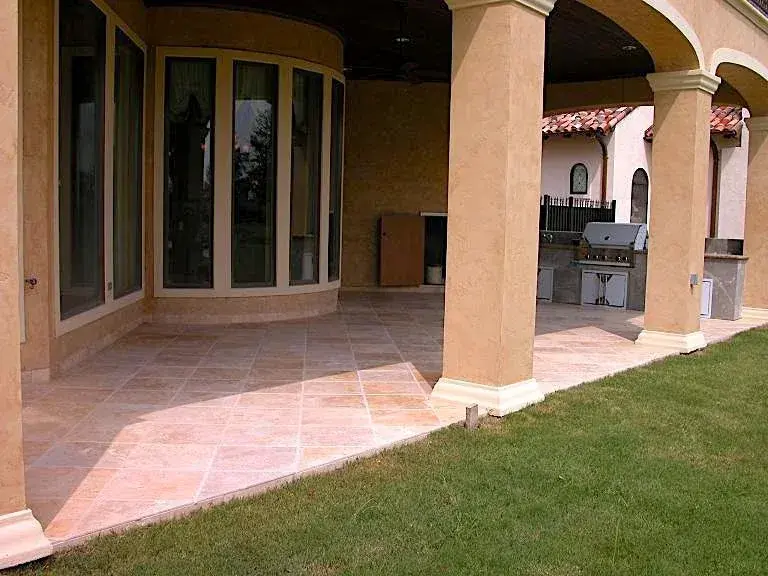
- Outdoor patios. Travertine, porcelain rated for outdoor use, flagstone, pavers over pedestals, or natural limestone on covered and uncovered patios. Slope-to-drain planned during set, expansion joints planned tight, and material selected for foot temperature in Texas summers. We also can solve differentiating height issues with floating floors that allow you to frame your patio without having to worry about drainage or the impact of swinging temperatures. These requests show up a lot on our high-rise balcony and terrace requests.
- Pool decks and pool coping. Tile or stone on the pool deck surface, coping at the pool edge, and the integration between deck and waterline tile. We coordinate directly with the pool builder so the tile sequences in cleanly with the shell, the coping, and the deck pour.
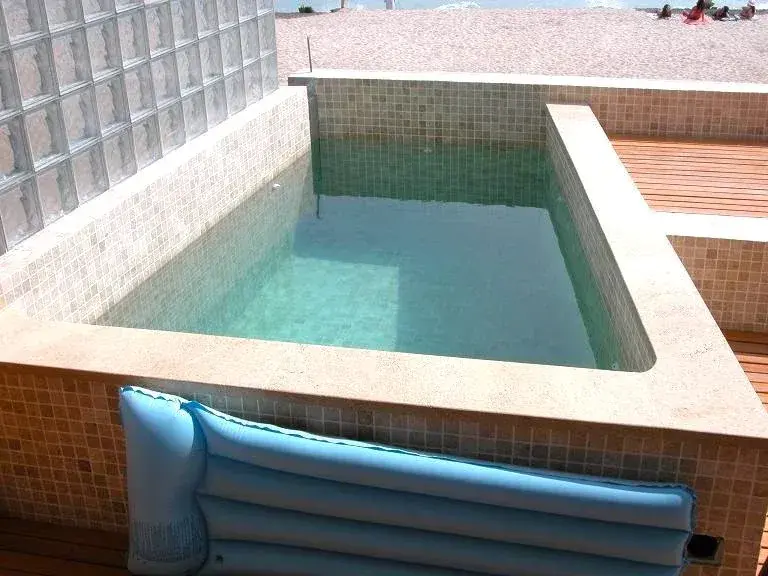
- Pool waterline tile and spa tile. Glass mosaic, ceramic, or stone at the waterline of a pool or spa, set in adhesives rated for constant submersion and pool chemistry. Often where a pool gets its strongest design moment. We also do fully tiled pools for that upscale Mexico resort vibe.
- Outdoor kitchens, fireplaces, and outdoor showers. Tile or stone on outdoor kitchen counters and surrounds, freestanding outdoor fireplaces, and outdoor shower walls and floors. Same craft as indoor work, with substrate, adhesives and methodology selected for the conditions.
Bookmatched seams, mitered edges, custom bullnose, glass mosaic accents, and stone-to-tile transitions all show up across these formats. Most are decisions that get made in the first design conversation.
How we install fireplace and outdoor Tile that lasts
A fireplace and an outdoor patio share a problem: the substrate behind the tile moves more than the tile does. A fireplace cycles between room temperature and hot enough to expand stone noticeably. An Austin patio sits through 100-degree summer days, then through a freeze that can drop a slab thirty degrees in a few hours. The tile, the adhesive, the substrate, the drainage and the expansion joints all have to be planned for that movement. Skip a step and the failure shows up as a cracked tile, a hairline grout failure, or a section that delaminates from the substrate after a season.
For fireplace work, every install starts with the substrate and the clearance to combustibles. Tile lands on cement board or another non-combustible substrate, never directly on drywall around a firebox. Clearance from the firebox opening to anything tiled (and from tile to anything combustible like a wood mantel) gets planned to the firebox manufacturer’s spec and to local code. Heat-rated thinset and grout is used on anything close to the firebox; standard thinset gets used on the rest of the surround where the temperature stays moderate. Hearths get set on non-combustible substrate with the same heat-rated approach.
For outdoor work, every install starts with the slab. Concrete patios get checked for slope (a slight slope away from the house is required so water runs off rather than pooling), checked for cracks or movement at existing joints, and prepped with a primer and a polymer-modified thinset rated for exterior freeze-thaw cycles. Movement joints get planned tighter than for interior work, typically every eight to twelve feet across the field and at every existing slab joint, then filled with a flexible color-matched sealant rather than rigid grout. Tile selection matters here as much as installation. Travertine and porcelain rated for outdoor use are what we install most often in Texas because both handle the heat-to-freeze cycle without spalling, and porcelain in particular stays cooler underfoot in summer than darker stone. Or, based on client preference, natural stone like limestone or flagstone can be specified, with the appropriate sealing and expansion planning.
Pool work requires its own craft. Waterline tile gets set with an adhesive rated for constant submersion and for pool chemistry (chlorine, salt-system saline, calcium hardness shifts). Coping gets coordinated with the pool builder so the tile depth, the coping projection, and the deck elevation all line up. The waterline is the most-photographed inch of a pool, and the layout (centered cuts, corner detailing, mitered turns at the steps) gets planned before the first piece goes down - for durability, comfort, safety and visual appeal.
Tile is set to TCNA standards across the board. Outside corners can be mitered rather than capped with bullnose or trim, which is the detail designers ask for first when they walk a finished fireplace. Custom bullnose can be created for rounded edges where metal or other trim isn’t preferred or where comfort is a concern. Grout is color-matched and selected for joint width and exposure. Natural stone is sealed before grout, then again after.
The owner, Paul, is on every job site. He is there in the morning when the crew arrives and at the end of the day when they wrap up. The job site is cleaned daily and communication with the client is consistent. There is no project manager between you and the person actually responsible for the work.
“Floor to ceiling fireplaces become a centerpiece, artwork in a home’s primary hosting space. We treat our work like the measured craft work it is and our teams are expert craftsmen at their trade.”
Who we work with
We work best with homeowners, designers, builders, landscape designers and custom pool contractors who want the fireplace and outdoor tile to be part of the architecture of the home rather than an afterthought. Our typical project is a primary fireplace inside a larger renovation or new build, or a pool and patio installation in the West Austin corridor where the design supports natural stone, travertine, slab walls, and the substrate prep that makes them last in this climate. We coordinate directly with pool builders, landscape architects, and general contractors so the tile sequences in cleanly with the shell, the deck pour, the coping, and the rest of the build.
If the goal is the lowest bid, we are not the right fit. If the goal is a fireplace or patio that looks the way you or your designer dreamed and still looks that way decades from now, we are.
Materials and trade partners
We install ceramic, porcelain, natural stone, travertine, marble, limestone, glass mosaic, large-format tile and slab in fireplace and outdoor applications. The materials we work with most often come through long-standing relationships with Ann Sacks, Materials Marketing (where most of our travertine and limestone gets specified), Architerra, Stone Solutions, Travis Tile, Daltile, and Emser. Each of those shops has in-house designers who can walk you through specification before tile reaches the site, and if you are already working with your own designer, pool builder, or general contractor who has a preferred tile partner, we coordinate with them directly.
Frequently asked
How long does a fireplace surround take to install?
Most traditional surrounds run three to seven days from start to finish, depending on the material, the height of the surround, and whether the hearth is being rebuilt at the same time. A floor-to-ceiling fireplace with mitered corners takes longer because of the layout planning and cutting.
Do you handle clearance to combustibles and code requirements?
Yes. Clearance from the firebox to anything tiled, and from tile to any combustible material (wood mantel, drywall edge, trim), gets planned to the firebox manufacturer's spec and to local code. We use non-combustible substrate behind any tile that sits close to the firebox and heat-rated thinset and grout on the surround itself.
Can you tile around a working wood-burning fireplace?
Yes, with the right substrate, the right adhesives, and the right clearance. Wood-burning fireboxes get hotter than gas and require tighter attention to the heat ratings and the clearance specs, but the install approach is the same: non-combustible substrate, heat-rated adhesive on anything close to the firebox, and a designed expansion plan so the tile can handle the heat cycling.
Do you do outdoor patios in Austin's climate?
Yes, regularly. Travertine and outdoor-rated porcelain are what we install most often because both handle Texas summer heat and the occasional hard freeze without spalling or cracking. We use polymer-modified exterior thinset, plan movement joints tighter than for interior work, and slope the surface so water runs off the slab rather than pooling. We also do floating floors or pavers on pedestals for areas that have the largest climate swings or issues.
Will outdoor tile crack in a freeze?
Outdoor-rated tile installed correctly does not crack in a freeze. Cracking on an outdoor patio almost always traces to one of three things: the wrong tile (interior-rated tile used outdoors), the wrong adhesive (interior thinset that doesn't tolerate freeze-thaw), poor prep, or movement joints that weren't planned tight enough. We spec all to the conditions.
Do you do pool tile and pool coping?
Yes. Waterline tile, full pool tile, deck tile, coping, and spa tile are routine work for us. We coordinate directly with the pool builder so the tile sequences in cleanly with the shell pour (or remodel), the coping fabrication, and the deck. Adhesives and grout are selected for pool chemistry and constant submersion at the waterline.
Travertine or porcelain for my Austin patio?
Both work. Travertine is the classic choice for Texas patios and reads warmer and more natural; porcelain is the modern alternative and stays cooler underfoot in direct summer sun, which matters around a pool deck. Floating floors offer pavers that could be made of natural stone, wood or other material. We will walk through the trade-offs (cost, sealing requirements, color range, surface temperature) on the site visit.
Do you do outdoor kitchens and outdoor fireplaces?
Yes. Outdoor kitchen counters and surrounds, outdoor fireplaces, and outdoor shower installs are all part of our work. Same craft as indoor, with substrate, adhesives, and material all selected for the exposure.
How do I get an accurate estimate?
We need to see the space, take measurements, look at the substrate condition (existing slab, firebox condition, pool shell), and talk through the design with you on site. A rough ballpark is possible over the phone with a few details, but the firm number comes after the site visit where options are discussed and exact measurements taken.